
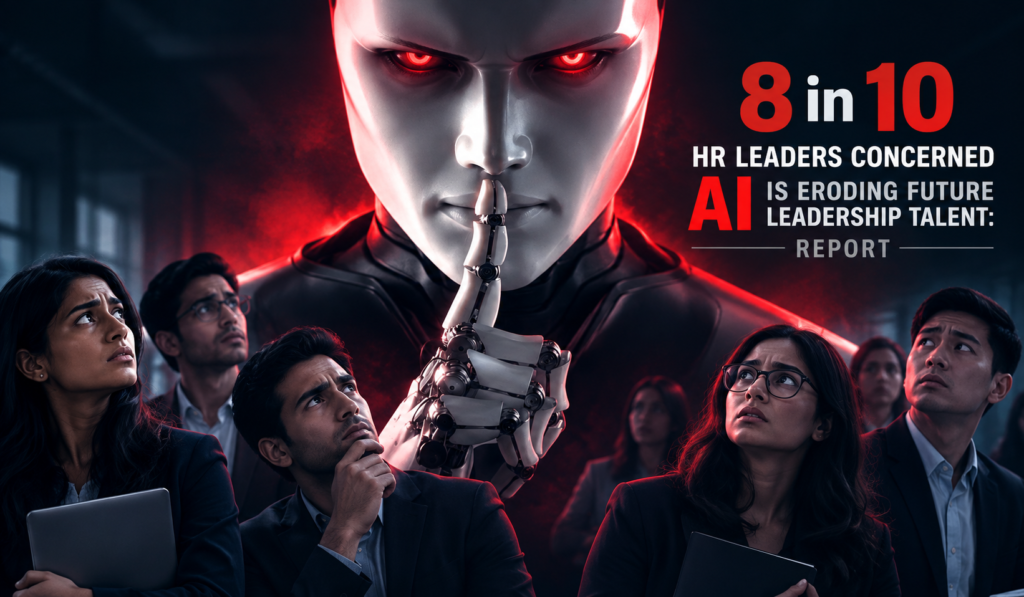
NEW YORK — Rapid artificial intelligence adoption is eroding the traditional corporate training ground, leaving human resources executives worried about where tomorrow’s executive talent will come from.
According to new research from global talent assessment firm Talogy, nearly 80% of senior HR decision-makers, talent acquisition managers, and learning leaders fear the enterprise will suffer a long-term deficit of critical leadership skills as automated systems dismantle conventional entry-level work.
Historically, low-stakes junior roles served as a crucible for emerging professionals to build workplace judgment, master problem-solving, and observe executive dynamics. As autonomous tools and AI agents swallow routine workloads, organizations risk breaking the developmental bridge that turns junior staff into future executives.
The Assessment Gap: Automation Outrunning Human Readiness
While workplace automation has accelerated across sectors—from financial services to healthcare and technology—talent evaluation frameworks have failed to keep pace.
Talogy’s survey of 207 senior talent leaders across the United States and the United Kingdom found that 78% struggle to evaluate AI-related capabilities because current assessment frameworks remain overly generic. Furthermore, while 95% of respondents confirm that AI now automates tasks inside their organizations, only 38% feel adequately equipped to revise job descriptions and redesign career progression pathways.
“AI is evolving faster than our ability to understand what good AI-human performance looks like,” the study noted, highlighting a growing disconnect between technical adoption rates and workforce readiness.
The urgency is compounded by wider industry shifts. Deloitte research indicates that nearly three-quarters of enterprise executives anticipate redesigning or rebuilding half their operational systems around autonomous AI agents within four years. Yet, only one in five organizations report being prepared to manage that scale of autonomous workflow.
Junior Roles ‘Seniorised’ Amid the Enablement Illusion
The disruption is already visible across the hiring landscape. Data from PwC’s AI Jobs Barometer indicates that entry-level job openings have flatlined in heavily exposed sectors. At the same time, “seniorised” junior postings—entry positions that demand advanced capabilities such as strategic leadership—have surged by 35% since 2019.
This trend creates an acute bottleneck for early-career professionals. Research from Gartner reveals an “enablement illusion,” where organizations mistake software rollouts and tool access for genuine workforce transformation. Gartner found that 73% of employees utilizing AI most productively are senior managers or executives, leaving frontline contributors underserved by capability development programs.
“Most leaders are mistaking basic access or adoption metrics for transformation,” explained Swagatam Basu, Senior Director Analyst at Gartner’s HR practice. “This ‘enablement illusion’ is hiding risks and draining ROI.”
Deloitte further cautions that organizations taking a purely technology-centric path to automation are 1.6 times more likely to fall short of projected returns compared to peers pursuing human-centered integration.
The RISE Model: Rebuilding Intentional Leadership Development
HR experts stress that shielding future leadership pipelines requires moving beyond basic software tutorials toward deliberate, early-stage behavioral development.
“Teaching employees how to work alongside AI tools simply isn’t enough,” said Ali Shalfrooshan, Director of Science Strategy at Talogy and author of the report AI and the Leadership Pipeline: The Rising Need for Intentional Development. “We must be far more intentional about cultivating core human capabilities, such as critical thinking, adaptability, and collaboration, if we are to enable people to take on complex responsibilities over time.”
To counteract pipeline erosion, Talogy synthesized data from more than 6,000 global workers and leaders into the RISE framework, targeting four core human competencies:
- Responsiveness: Agility and openness to engage dynamically with emerging workflows.
- Insight: Critical evaluation, complex problem-solving, and autonomous idea generation.
- Sustainability: Resilience and mental stamina to perform effectively through structural disruption.
- Effectiveness: Cross-functional collaboration and communication skills that translate concepts into execution.
To safeguard the future executive bench, industry analysts advise talent leaders to deploy objective, science-based psychometric and behavioral assessments early, ensuring organizations identify and nurture high-potential leaders before foundational skills disappear.